Sunday, 28 August 2016

ARTIST RESEARCH Kiki Smith

Rationale
A quick google image search of Kiki Smith and I instantly resonated with her work conceptually and aesthetically. In particular the aesthetic, which conveys an 'otherness', has informed my own practice. Tho I have chosen to head in a different direction regarding the level of abstration and manipulation of the human form. 

Kiki Smith (born January 18, 1954) is a West German-born American artist [1] whose work has addressed the themes of sex, birth and regeneration. Her figurative work of the late 1980s and early 1990s confronted subjects such as AIDSgender and race, while recent works have depicted the human condition in relationship to nature.
Using a multitude of mediums and materials, Kiki Smith’s collections are meditations on life and spirituality, often featuring narratives about origins and endings. 
source: https://en.wikipedia.org/wiki/Kiki_Smith

http://www.yellowdoorartmarket.com/.a/6a0134868a53d2970c01b8d17d6095970c-800wi


https://s-media-cache-ak0.pinimg.com/564x/06/d2/d7/06d2d764e6f4b7351f42909968fd8484.jpg

Tuesday, 23 August 2016

ARTIST RESEARCH Robert Gober

Rationale
Robert Gober is an artist that was recommended to me in my early stages of research. While I have not used him as an influence in this project he was an interesting artist for me to look at in regards to where I am not intending on heading within my own work. In the examples I have looked at he has used blatant christian iconography, that comes loaded with their own history, which strengthens his work. I have touched on using christian iconography previously in my own work but feel a resonance with it.


Installation View, Los Angeles Museum of Contemporary Art, Madonna Detail, 1997. Troubling the Banal
(image source) http://www.transpositions.co.uk/wp-content/uploads/2012/02/Robert-Gober-Installation-View-The-Los-Angeles-Museum-of-Contemporary-Art-19971.jpg
Matthew Marks Gallery Installation, Crucifix , 2005
https://s-media-cache-ak0.pinimg.com/originals/e6/b9/c4/e6b9c4a7d03cf8c2ea27c48ee5bcb59a.jpg

In his seminal essay ‘The Return of the Real’, Hal Foster explores the hidden aims within the broad, revived interest in realism and illusionism that characterizes Gober’s generation of artists. Alongside his discussion of ‘traumatic realism’ and ‘traumatic illusionism,’ Foster elaborates on the appropriation and explains that ‘appropriation art works to expose the illusions of representation, it can poke through the image-screen.’ Reflecting further on Gober and artists like him, Foster notes that ‘Here illusionism is employed not to cover up the real with simulacral surfaces but to uncover it in uncanny things.’ While the sheer accumulation of everyday objects rendered illusionary or abject by Gober’s practice would serve to arrest any viewer, it is his profound construction of quasi-religious and ominously spiritual spaces that represents his greatest effort at troubling the banality of our lives. Gober’s most remarkable spaces have involved the studied and precise transformation of near kitsch-y religious objects.


In September 1997, Robert Gober displayed his untitled, site-specific installation in the Geffen Contemporary gallery of the Museum of Contemporary Art in Los Angeles. Somewhere between a serenely empty home space and a calm chapel, the installation has at its center a sculpted Madonna pierced through with a culvert pipe. Loosely based on an almost kitsch-y garden sculpture of Mary and adapted with help from a live model, Gober crafted this Madonna with his own hands, and in the eerie space of the installation it retains none of its garden store familiarity.
Gober appropriated another piece of religious kitsch for a large-scale installation at the Matthew Marks gallery in New York City, which he described thus: ‘The exhibition, its contents, its themes, and its materials were in some deep way related to the events on September 11, 2001.’ The headless cement crucifix remains the pseudo-chapel’s focal point and encapsulates the grief-stricken mood of the space. Based on a family heirloom handed down to the artist by his grandmother, the crucifix assumes a strange scale, not a monument and yet not a miniature. Like the Madonna before it, Gober took great care in sculpting the crucifix himself and in his way has ensured its solemn presence and spiritual portent.

http://www.transpositions.co.uk/robert-gober-troubling-the-banal/


ARTIST RESEARCH Janine Antoni

Rationale
Janine Antoni was also a recommended artist in my early stages of research. I found her use of the human body intriging as well as the resulting aesthetic of 'lick and lather' where the busts facial features were reduced to a ghostly visage. Her work has informed my project to a greater degree in advanced fabrication and construction where I am exploring claritas and the human form. 

Janine Antoni (born January 19, 1964, in Freeport, Bahamas) is a contemporary artist, who creates work in performance art, sculpture, and photography. Antoni's works focus mostly on process and the transitions between the making and finished product. She often uses her body, as an entity or paying particular attention to body parts as tools, utilizing her mouth, hair, eyelashes, and, through technological scanning, the brain, to perform everyday activities to create her artwork


Saddle
(image source):https://d1lfxha3ugu3d4.cloudfront.net/fab/images/194.661.jpg


Janine Antoni, If I Die Before I Wake (mother's hand meets daughter's hand in prayer), 2004 Porcelain nightlight with electrical fixture Edition of 25 and 5 artist's proofs 5 3/8 x 4 1/4 x 6 inches (13.65 x 10.8 x 15.24 cm)
(image source):https://farticulate.files.wordpress.com/2011/04/7ac8b68f.jpg


Janine Antoni, "Lick and Lather," detail, 1993. 7 soap and 7 chocolate self-portrait busts, 24 x 16 x 13 inches each. Collection of Jeffrey Deitch, New York. Photo by John Bessler. Courtesy the artist and Luhring Augustine
(image source):http://www.art21.org/files/images/antoni-sculpt-003.jpg

Lick and Lather (1993), Antoni produced fourteen busts, seven cast from chocolate and the other seven from soap. She then "re-sculpts" the busts by eating them (chocolate) and bathing herself (soap) as the title suggests

ARTIST RESEARCH Gavin Turk

Rationale
Gavin Turk was one of the recommended artists to research in regards to this project due to his use of the human form and connection to identity. As with Mark Quinn I have chosen to move away from a realistically representational form and develope my own abstracted form.


https://nicholasspyer.files.wordpress.com/2010/03/gavin-turks-pop-1993-part-004.jpg?w=500

http://www.domusweb.it/content/dam/domusweb/en/art/2012/05/22/gavin--turk/big_384329_4764_we-selfportrait1.jpg/jcr:content/renditions/cq5dam.web.1280.1280.jpeg

With its themes of identity, appropriation and the ambiguity of authorship in contemporary art, Gavin & Turk is a suitably schizophrenic title for a recent exhibition at London's Ben Brown Fine Arts gallery. The show is the latest offering from Gavin Turk, the British artist who gained notoriety for his graduation piece at the Royal College of Art in 1991; an empty studio that contained just a blue English Heritage plaque bearing the words "Gavin Turk worked here 1989-91". This act may have cost Turk his degree, but it secured his place as one of the generation of Young British Artists (YBAs) who rose to prominence in nineties Britain. The YBAs' strategies of self-promotion raised questions about the artist's identity in a media and market-saturated discipline that Turk then made the basis of his practice, as in Pop (1993), a self-portrait that simultaneously referenced Sid Vicious, Elvis Presley and Andy Warhol. 

Gavin & Turk is a solo show entirely consisting of new works. Yet as its name suggests, this is still an exhibition about more than one man. It is billed as an homage to Alighiero Boetti, the Italian conceptual artist, who in the 1970s, started signing his workAlighiero e Boetti, a gesture that expressed his fascination in both wordplay and the messy duality of the self. It is timed to coincide with a major Tate Modern retrospective of Boetti, who was originally associated with the Arte Povera movement in the late 1960s.

Saturday, 13 August 2016

ARTIST RESEARCH Marc Quinn

Rationale
Again the primary reason for researching Marc Quinn was his use of the human form and use of religious connotations. I chose to move away from a realitically representational form and develope my own abstraction. 

Marc Quinn (born 8 January 1964) is a British sculptor and visual artist. He is a member of the loose group known as the Young British Artists Quinn's oeuvre displays a preoccupation with the mutability of the body and the dualisms that define human life—spiritual and physical, surface and depth, cerebral and sexual.

Since 2006, Marc Quinn has made numerous studies of the supermodel Kate Moss. In April 2006, Sphinx, a sculpture ofKate Moss by Quinn was revealed.[17] The sculpture shows Moss in a yoga position with her ankles and arms wrapped behind her ears. This body of work culminated in an exhibition at the Mary Boone Gallery in New York in May 2007. The sculpture is on permanent display in Folketeatret in OsloNorway.[18][19]In August 2008, Quinn unveiled another sculpture of Kate Moss in solid 18-carat gold called Siren, which was exhibited at the British Museum in London. The life-size sculpture was promoted as "the largest gold statue since ancient Egypt".
source: https://en.wikipedia.org/wiki/Marc_Quinn


http://i.telegraph.co.uk/multimedia/archive/01572/kate-moss-sculptur_1572447i.jpg


https://lmicklefield.files.wordpress.com/2015/04/ac5cf4a02fe05b197fe6f903b03fc4fb.jpg

http://www.designboom.com/tools/WPro/images/11s/mq6.jpg

https://isabelgrundy.files.wordpress.com/2014/01/marc-quin.jpg

http://www.japantimes.co.jp/wp-content/uploads/2013/09/p12-onfashion-main-20130910-870x580.jpg


SOURCE: https://elephantwiththevision.files.wordpress.com/2014/02/img_1193.jpg

Wednesday, 10 August 2016

RESEARCH Christian meditation

http://www.totalwholeness.com/wp-content/uploads/2014/05/christian_meditation_1_ebook_1_copy_small.jpg


Meditation is a universal spiritual wisdom and a practice found at the core of all the great religious traditions, leading from the mind to the heart. It is a way of simplicity, silence and stillness. It can be practised by anyone, wherever you are on your life’s journey.
http://wccm.org/content/what-meditation


Prayer has been an essential part of Christianity since its earliest days. As the Middle Ages began, the monastic traditions of both Western and Eastern Christianity moved beyond vocal prayer to Christian meditation. These progressions resulted in two distinct and different meditative practices: Lectio Divina in the West and hesychasm in the East. Hesychasm involves the repetition of the Jesus Prayer, but Lectio Divina uses different Scripture passages at different times and although a passage may be repeated a few times, Lectio Divina is not repetitive in nature.[1][2]
The progression from Bible reading, to meditation, to loving regard for God, was first formally described by Guigo II, aCarthusian monk who died late in the 12th century.[3] Guigo II's book The Ladder of Monks is considered the first description of methodical prayer in the western mystical tradition.[4]
In Eastern Christianity, the monastic traditions of "constant prayer" that traced back to the Desert Fathers and Evagrius Pontikos established the practice of hesychasm and influenced John Climacus' book The Ladder of Divine Ascent by the 7th century.[5] These meditative prayers were promoted and supported by Saint Gregory Palamas in the 14th century.[1][6]

From the 18th century some components of meditation began to be de-emphasized in some branches of Western Christianity.[7] However, the early part of the 20th century witnessed a revival and books and articles on approaches such asLectio divina aimed at the general public began to appear by the middle of the century.[7]

Christian meditation and contemplation

In discursive meditation, mind and imagination and other faculties are actively employed in an effort to understand our relationship with God.[3][4] In contemplative prayer, this activity is curtailed, so that contemplation has been described as "a gaze of faith", "a silent love"
In Christian mysticismcontemplative prayer or contemplation, for which the Greek term θεωρία theoria is also used,[1] is a form of prayer distinct from vocal prayer (the recitation of words) and, strictly speaking, from meditation (a form of mental prayer, also called methodical prayer, based on discursive reflection on various considerations
Christian meditation is a form of prayer in which a structured attempt is made to become aware of and reflect upon the revelations of God
Christian meditation aims to heighten the personal relationship based on the love of God that marks Christian communion.[3][4] Both in Eastern and Western Christianity meditation is the middle level in a broad three-stage characterization of prayer: it involves more reflection than first level vocal prayer, but is more structured than the multiple layers of contemplative prayer.[5][6][7][8] Teachings in both the Eastern and Western Christian churches have emphasized the use of Christian meditation as an element in increasing one'sknowledge of Christ

Stages of infused contemplative prayer
Saint Teresa of Avila described four degrees or stages of mystical union:
  1. incomplete mystical union, or the prayer of quiet or supernatural recollection, when the action of God is not strong enough to prevent distractions, and the imagination still retains a certain liberty;
  2. full or semi-ecstatic union, when the strength of the divine action keeps the person fully occupied but the senses continue to act, so that by making an effort, the person can cease from prayer;
  3. ecstatic union, or ecstasy, when communications with the external world are severed or nearly so, and one can no longer at will move from that state; and
  4. transforming or deifying union, or spiritual marriage (properly) of the soul with God.
Christian meditation is different from the style of meditations performed in Eastern religions (such as Buddhism) or in the context of the New AgeWhile other types of meditation may suggest approaches to disengage the mind, Christian meditation aims to fill the mind with thoughts related to Biblical passages or Christian devotions.[31] Although some mystics in both the Western and Eastern churches have associated feelings of ecstasy with meditation, (e.g. St. Teresa of Avila's legendary meditative ecstasy), St. Gregory of Sinai, one of the originators of Hesychasm, stated that the goal of Christian meditation is "seeking guidance from the Holy Spirit, beyond the minor phenomenon of ecstasy"


In Christianity this tradition of contemplation, the prayer of the heart or 'apophatic prayer', became marginalised and often even sometimes suspect. But in recent times a major recovery of the contemplative dimension of  Christian faith -and prayer - has been happening. This is transforming the different faces of the Church and revealing the way the Gospel integrates the mystical and the social. Central to this process now is the rediscovery of how to pray in this dimension and at this depth: finding a practice of meditation in the Christian tradition.
http://wccm.org/content/what-meditation


ABOVE: What is meditation ? by Laurence Freeman OSB
https://youtu.be/8NK1jQM-Gwk?list=UUVyZr8UvruQcx05H7TYnA_g

RESEARCH Positioning of the figure

Rationale
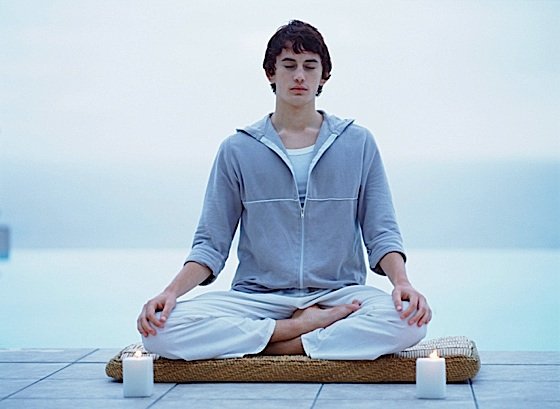
The following images were collected and used as reference images in the creation of the marqette. The posture which is used in the final artwork was chosen as it is not instantly recognisable to any one religion, even tho it is used in 'new age' christian meditation practices. 

http://www.totalwholeness.com/wp-content/uploads/2014/05/christian_meditation_1_ebook_1_copy_small.jpg

http://cdn.c.photoshelter.com/img-get/I0000OPsPBhZSB8Q/s/600/480/SFE-050320-0002.jpg

https://blogger.googleusercontent.com/img/b/R29vZ2xl/AVvXsEgdxE3tT49oeU0zp2_JPCKg0w-t0fvZP2Q9U_7KcimcBCWxmeH9RXPXZ4lxJXU5xJ-ZQ7_4uLGN8uNTXAh5BrhIGARgR9Eqhf2nmqCyNMq6HjhxD9s9P5-5pRCwOKRq9iCzUASCb2clwqDn/s1600/meditating+Jesus.jpg


http://wccm.org/sites/default/files/users/General_Images/meditation_generalbest.jpg

https://upload.wikimedia.org/wikipedia/commons/thumb/d/d3/Phra_Ajan_Jerapunyo-Abbot_of_Watkungtaphao..jpg/300px-Phra_Ajan_Jerapunyo-Abbot_of_Watkungtaphao..jpg


http://edguidance.com/wp-content/uploads/2015/07/meditation.jpg


http://www.ourgom.com/wp-content/uploads/2015/09/handsome-bare-chested-man-meditation-yoga.jpg


http://www.buddhaweekly.com/wp-content/uploads/2013/05/Buddha-Weekly-1Seated-meditation-best-for-calming-minds.jpg


https://s-media-cache-ak0.pinimg.com/236x/35/b5/7e/35b57e9f125d990a9ae27ae53f8a3545.jpg

Sunday, 7 August 2016

RESEARCH Understanding Identity


SOURCE:https://oma.ku.edu/sites/oma.ku.edu/files/files/identity-510866_640.jpg


Understanding Identity

"Go look at a beach full of semi-naked people. Get us away from our houses and possessions, make us take our clothes off and surrender our job titles, stop us talking so that we don't fudge the issue with words, and there is not much left to tell us apart. "[1]
We are all the same species arent we ? Built on the same model.
We are both generalisations and particularities.

We have to study the outside and the inside at the same time to understand identity

Identity come from two main forms. The self and The perceived self.

The self is how you see yourself ( the inside) , The perceived self is how others see you (the outside).


The perceived self or external identity

This is made up of a combination or all of the following and is easy to define as they are visible and tangiable:

Your name
Your body   having a body rather than being a body
Your voice and sound
Your smell
Your face
A representation of your face (photograph)
A document about you ( your wallet/purse is full of them)
The digital signature you
The categorised you ,  gender , nationality, race, language, religion, residence, age, education, job title, marital status , dependants etc
The qualified you - everyone who knows you, friends, family and enemies.
The historical you, past you, your up bringing, family, genes, beliefs
Your reputation
The Virtual you 
The material you, DNA, finger print, you are a living organism, homo sapien


the self ( the inside)

There is an unbridgable gap between the intimate self and the rest of the world.The inner self is insubstantial. The outer self really has nothing to do with you at all. The important elements of identiy are inside and are out of reach. You cannot see or touch your own. You cannot prove that they are there, let alone describe how they work.
the indefinable you - "i am this sensation in here. that is all i am"
My solitude and Autonomy , you are alone, other people cannot hear or see "you"
The Hub of My Senses and Instincts , you are a receptor of sight, sound, touch, taste and smell. I expereince and interpret
The mind
Self-Consiousness - You are aware of yourself and this can lead to a sense of responsibility and conviction as you have free will. Consiousness has two meanings: to be awake and to be aware.
The Person Behind the Personality. My character seems to be part of the outside world. and a sense of control or loss of.
Self-instruction - sporadic mental chatter, monologue or dialogue. Sometimes helpful or hindering.
Purposeful thinkin - the brain monitors situations deciding whether or not to take action
Imagination: Your imagination uses your senses as its language allowing you to refect on what is not infornt of you, to go backwards and forwards in time, or to travel without moving or to create things that have never existed
The memory of you: for identity to work, you must remember who you are. You can only be what you recall
The suffering you : what you go through on a daily basis, enduring, self inflicted or through accident
self criticism, failure, regrets, loneliness
The end of you : is death the end of your life, your identity your everything.


On a daily basis we keep most identity transactions to the lowest possible level during social intercourse.


Identity crisis

Learned Identity: the one we were taught or raised
Discovered Identity: one found during the journey of life. A talent that is revealed through an opportunity
Decided Identity: result of the choices we made, a job, marriage, kids
Circumstancial Identity or Chance: such as an accident or decision taken by someone else
Declined or Anti-identity: formed from an opportunity we didnt not take
A identity crisis usually occurs during a change between these categories
,

Why is understanding identity important
You cant know anything if you dont know who you are.
To know yourself is to be free and know the differences between:

  • speculation and fantasy and the real you
  • the fixed elements of your identity and those that can be changed
  • your conditioning and the consequences of the decisions of your free will
  • the fores within your control and those beyond your control
  • psycological projection on other people


[1] Nick Inman, Who on Earth are You?  Scotland:Findhorn press, 2013

Tuesday, 2 August 2016

ARTIST RESEARCH Antony Gormley

Rationale
Antony Gormley's portayal of the human figure has been a key inspiration to my usage of the human form across all of my studio areas in 2016. Through casting of his own body he produces human figures, but instead of producing works that are realistic he reduces the form. Exploring the internal and external spaces of the self. I was drawn to the work 'The Angel of the North' due to its title, use of the human form, and that it was an outdoor installation. It was originally apart of my research into artworks that used religious connotations. 


Sir Antony Gormley - The Angel of the North


According to Gormley, the significance of an angel was three-fold: first, to signify that beneath the site of its construction, coal miners worked for two centuries; second, to grasp the transition from an industrial to an information age, and third, to serve as a focus for our evolving hopes and fears

.Gormley describes his work as "an attempt to materialise the place at the other side of appearance where we all live." Many of his works are based on moulds taken from his own body, or "the closest experience of matter that I will ever have and the only part of the material world that I live inside." His work attempts to treat the body not as an object but a place and in making works that enclose the space of a particular body to identify a condition common to all human beings. The work is not symbolic but indexical – a trace of a real event of a real body in time.

ARTIST RESEARCH Alberto Giacometti

Rationale
Alberto Giacometti's Walking man has been described as "managed to capture the decisive moment where a man reveals an internal strength which stems from his own energy and momentum." It is the stylised male figure, with no individualised aspects that conveys the human condition. My own interest for this project is to reduce the human form down to its basic components. I am interested in the generalities not the particularities of the individual to create that connection to the self
.

Alberto GIACOMETTI (1901 - 1966)
WALKING MAN I


SOURCE:https://maryckhayes.files.wordpress.com/2010/08/giacometti-walking-man-i.jpg

SOURCE:https://blogger.googleusercontent.com/img/b/R29vZ2xl/AVvXsEjTHJz84Ggy-LLNmoVvUrqV0VMhg6TszATY3hz08eIdM47SFEs2nO083ppkS82o9AQOfMu5llWnrNz1QoHG4k2pgJiotmQvZAkbbOzgDS-iqMd5UohzZ4WNQoEFAS-5F29Oql3tJW8f9yem/s1600/LI-sculp-AIC-271b.jpg


Bronze sculpture, inscribed 'Alberto Giacometti' and 'Epreuve de l'UNESCO' (UNESCO proof) on the base; with foundry mark Susse Fondeur Paris.
183 x 25.5 x 95  cm 


Date of entry at UNESCO 
December 1970 

Acquisition made by UNESCO in 1969. 

Country of origin 
  Switzerland 


Alberto Giacometti created a filiform and stylized figure, whose limbs seem to stretch out endlessly, as a symbol of the human being. A combination both of strange fragility and strong determination is expressed in this unrealistic figure. 

Impenetrable yet disconcerting, Giacometti’s male figure has no individualized aspect; he is depicted only with his strangely uneven skin. Because of the lack of specific identification on his face, this figure exalts a universal impact which exerts an intriguing fascination on the spectator. Through this sculpture, Giacometti managed to capture the decisive moment where a man reveals an internal strength which stems from his own energy and momentum. 

Alberto Giacometti’s walking man does not ask himself any questions; he simply comes from somewhere and is on his way elsewhere. His gaze fixed on the horizon, he strides decisively, forward in order to discover, to understand, as if he has a goal to pursue. With an awakened conscience, he travels through time to observe the world. His feet, anchored in the ground, connect him inevitably to the earth with which he is one. It is the whole body which here moves through an oblique force, towards a future to be created.

SOURCE:http://www.unesco.org/artcollection/NavigationAction.do?idOeuvre=2919

ARTIST RESEARCH Marina Abramović

Rationale
I was particalarly insterested in the interactive aspect of Mariana Abramovic's 'a minute of silence' and how it explores the relationship between the performer and audience.I was also interested in the the recording process of the experience for participants and found the film 'the artist is present' which documents the exhibition. The discussion of how a performance artist commercialises their work for galleries through photographic and film documentation was of particular interest. 


Marina Abramovic "A minute of silence" 


SOURCE: https://www.youtube.com/watch?v=mEcqoqvlxPY


SOURCE:http://cdn.thedailybeast.com/content/dailybeast/articles/2012/01/23/marina-abramovi-s-silent-revolution-in-performance-art/jcr:content/image.crop.800.500.jpg/44244429.cached.jpg

Abramović sat in a chair in the gallery for eight hours a day, while visitors streamed in and, one by one, occupied the chair opposite her. Some wept; others laughed. At least one took off all her clothes and had to be removed by security. For three months, Abramovic sat there, impassive, during which time The Artist is Present drew record crowds to the gallery and became one of the most famous and controversial pieces of performance art ever staged. 

"I've never done anything as radical as this. This is as immaterial as you can go."

Marina Abramovic


Before the show opened, both Abramović and MoMA half worried that no one would turn up. As the thing took off, celebrities started to drift in to sit opposite her, including, inevitably, James Franco – and then Ulay came. Abramović broke protocol and reached out to grasp his hands across the table. Everyone cheered. "I absolutely didn't expect he'd come to sit. The moment he sat – and everyone got very sentimental about it, because they were projecting their own relationships on to us – but it was so incredibly difficult. It was the only time I broke the rules."

" I understand that you can bring out the worst in people and the best. And I found out how I can turn that into love. My whole idea at MoMA was to give out unconditional love to every stranger, which I did. And the other one was a challenge to every bad energy possible; if you give the guy a chain saw ... you are provoking him."

Marina Abramovic


Marina Abramović is a Yugoslav performance artist based in New York.[1] Her work explores the relationship between performer and audience, the limits of the body, and the possibilities of the mind. Active for over three decades, Abramović has been described as the "grandmother of performance art." She pioneered a new notion of identity by bringing in the participation of observers, focusing on "confronting pain, blood, and physical limits of the body."

SOURCE: https://www.theguardian.com/artanddesign/2014/may/12/marina-abramovic-ready-to-die-serpentine-gallery-512-hours

ARTIST RESEARCH Nam June Paik

Rationale
My original intention for looking at Nam June Paik was due to his use of religious iconography, his connection to it. I was also interested in the use of that iconography not being a comment about the theological backgrounds of that belief, but instead being an analogue for his own culture and the connection to western culture.

Nam June Paik - TV Buddha


“Paik’s possibly most famous video work was produced as a gap-filler for an empty wall in his fourth show in the Galeria Bonino, New York. Shortly before the opening, he hit upon the idea of making a TV viewer out of an antique Buddha statue once purchased as an investment. The subsequent addition of a video camera meant the Buddha now watched his videotaped image on the screen opposite – past and present gaze upon each other in an encounter between Oriental deity and Western media.

During the ‘Projekt '74’ exhibition in Cologne, Paik took the Buddha’s place in his recent creation, suggesting the implicit antithesis between transcendentalism and technology was equally present in his own personality.”

Nam June Paik (July 20, 1932 – January 29, 2006) was a Korean American artist. He worked with a variety of media and is considered to be the founder of video art.

Source:https://www.tumblr.com/search/tv-buddha
Source:http://www.medienkunstnetz.de/works/tv-buddha/

Initial brainstorm for the project

Project 1: The Body, Identity and The Self

Area of focus for the project:
The Body as Spiritual and Immaterial, The Body in Time, Space and Sound


extend the projects from fabrication and construction where i explored claritas, the human form  and materiality.
                the relationship between the environment and the self
             

connection and disconnection between the self and environment

Glossolalia or speaking in tongues, according to linguists, is the fluid vocalizing of speech-like syllables that lack any readily comprehended meaning, in some cases as part of religious practice in which it is believed to be a divine language unknown to the speaker.

Materiality
The concrete  just as we are organic our physicality is disperate from nature
material relates to the "be still" , it is a lifeless material, man made, particularly in the city it is a material that is our enviroment

posture
the figure is positioned in passive sitting position with hands placed at sides. Not intentionally in any particular known prayer position. 


research question:
what is identity
how do you find yourself
how do you go beyond the physical

meditation, contemplation, seeking solitude, fasting, blocking out the work, stillness


Artists
Nam June Paik       buddah looking at tv
Marina Abramović, “The Staring Woman at MoMA”
anthony gormley
giocometti - walking man

mark quinn - flowers ... blood head
gavin turk  - human body
janine antoni   soap torsos - internalises and externalises

robert gober -
charles ray - manequins

make several digital mockups - one made out of paper, one made out of concrete
outdoor installations
materials

be still and know that i am


  • What do you want to do?
You will need to outline your ideas, inspiration, sources and references. Start to build up a bibliography of books (artists, writers) that support your ideas or are in some way linked to your work.

Explore how others connect spiritually, how do you go beyond the physical.

create a potentially interactive artwork
add element of sound
artwork is effected by environmental lighting, light and dark( furthering claritas ) 


  • How do you plan to go about it?
This should describe methods, processes and materials. You should identify where you plan to source these materials and identify processes or skills you might need to know or learn how to do.

The intention is to create two low plinths and one human form which are intended to be visual ques to the concept of identity. One one of the plinths a to scale abstracted human form will be seated. Which will discuss the external identity. The empty plinth discussing the internal identity. This empty spot is an invitation to the viewer to become a participant, in search of their own "self"

  • When do you plan to do it?
This is to be like a time line that plots out timing for realising the work. It should identify key points when certain elements, are required to be finished.

begin construction of marquette in week 4
begin construction of final in week 6
review of artwork in week 7
complete figure by week 9
complete work by week 13

  • Where do you plan to exhibit the work?
You will need to experiment with context, placement and location actively. Don’t wait to think about this when the work is completed. It should be a component of the ideas of the work from the start and may influence the realisation of the work dramatically.

final location is site specific to kingscliff
for evaluation in the white box - materiality of figure will be considered for white box

  • What are the Risks?
There are risks of some sort with virtually all artwork. Consider what the risks might be in developing your project. The risks might be about storage and safety of work, it might be about the impact of the work on other students using the studio, as well as the safety of the materials you are using. It is important that you develop a sense of individual responsibility for establishing safe working conditions for yourself, and ensuring what you do does not impact negatively on the other users of the workshop and studio.

working with concrete dust and steel will be dangerous to bystanders and myself.
suitable protection ie ventilator, gloves and full cover clothing will be needed